
In robotics development projects, especially those involving DIY robotic arms or biomimetic robots, servo jitter is a common problem that plagues countless developers. The back-and-forth wobbling of the output shaft not only affects the robot’s motion accuracy but also accelerates mechanical wear and can even lead to motor overheating and damage.
This article, based on professional materials, will provide a detailed breakdown of the root causes of servo jitter and introduce how to solve this problem using a professional debugging system, thereby improving robot performance.
1、Why does servo jitter occur?
Servo motor vibration is usually not caused by a single factor, but rather by a combination of factors including control signals, power supply, and mechanical structure.
● Signal and Power Issues: This is the most common cause. If the control signal is unstable, or if the frequency of commands sent to the servo is too high, the servo’s internal circuitry may be unable to accurately interpret the signal, causing the output shaft to vibrate. In addition, insufficient power supply can also lead to an inability to maintain torque, causing vibration.
● Mechanical and Load Issues:
● Load Mismatch: If the load exceeds the servo’s specified torque range, or if the robot’s joint design is unreasonable, resonance can occur.
● Loose Installation: If the servo gears are not securely installed or the mounting screws are loose, it will cause increased mechanical clearance, resulting in physical vibration.
● Inexpensive Servos: In DIY projects, using inexpensive servos often makes this problem more likely and accelerates mechanical wear.
Solution Recommendations: First, check if the screws are tightened and confirm that the load is within the torque range. Simple mechanical adjustments or replacing the servo with a higher torque servo can usually improve the situation immediately.
2、Core Solution: Using a Servo Trigger System
To completely eliminate jitter and improve control precision, introducing a professional servo tuning system is crucial.
①. Core Functions of a Tuning System
A complete tuning system goes beyond simply sending commands; it includes the following key capabilities:
● PID Parameter Fine-tuning: By adjusting the PID value, response delay and overshoot can be effectively reduced, a key method for eliminating electronic jitter.
● Motion Curve Analysis: Graphing the entire servo rotation process helps developers intuitively identify specific points of hesitation or jitter, thereby optimizing motion smoothness.
● Multi-Servo Synchronization and Diagnostics: Advanced functions allow simultaneous tuning of multiple servos, ensuring seamless joint operation; it also automatically detects faults such as overheating, overload, or signal loss, reducing maintenance costs.
②. How to Choose the Right Tuning Tool?
When selecting a system, focus on the following:
● Compatibility: Confirm whether the system supports the servo protocol you are using (such as a dedicated PWM system or a system compatible with smart bus servos).
● Ease of Use: Prioritize systems with intuitive graphical interfaces. Compared to pure code configuration, debugging tools with a mobile app allow even non-technical engineers to quickly get started and view angle, rotation speed, and temperature data in real time.
● Preset Modes: Check if the system provides preset debugging modes for robot gait or grasping actions, which will significantly save development time.
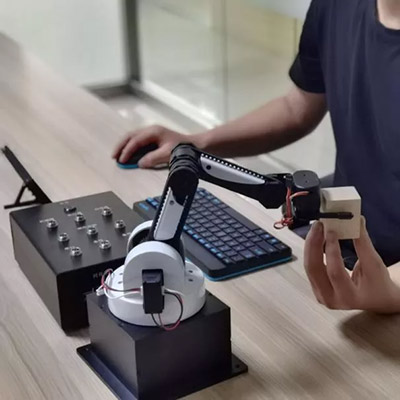
3.How can the debugging system improve motion accuracy?
Besides eliminating jitter, the calibration system can significantly improve the robot’s positioning accuracy, controlling errors to the millimeter level.
● Optimized acceleration curve: Setting an appropriate acceleration curve can reduce the inertial shock during servo motor startup, making movement smoother. This is especially important for robots requiring precise grasping or mapping.
● Mechanical error compensation: Over time, servo motor gear backlash may increase. The calibration function of the calibration system can automatically correct these deviations, compensating for the effects of wear and extending servo motor life.
4.Industry Applications and Future Trends
From education to industry, the application of servo motor tuning technology is becoming increasingly widespread:
● Education: Visual interfaces help students quickly understand control principles and design award-winning innovative projects.
● Industrial Inspection: By tuning response speed, robots can move smoothly in complex terrain, avoiding false alarms from sensors due to vibration.
Future Outlook: With the development of AI and IoT technologies, future tuning technologies will become more intelligent.
● AI-Assisted Tuning: The system will automatically recommend optimal parameters based on the task (such as “precise grasping”), lowering the technical barrier.
● Cloud Collaboration: Combined with IoT, developers can remotely monitor and update the firmware of robots worldwide in real time.
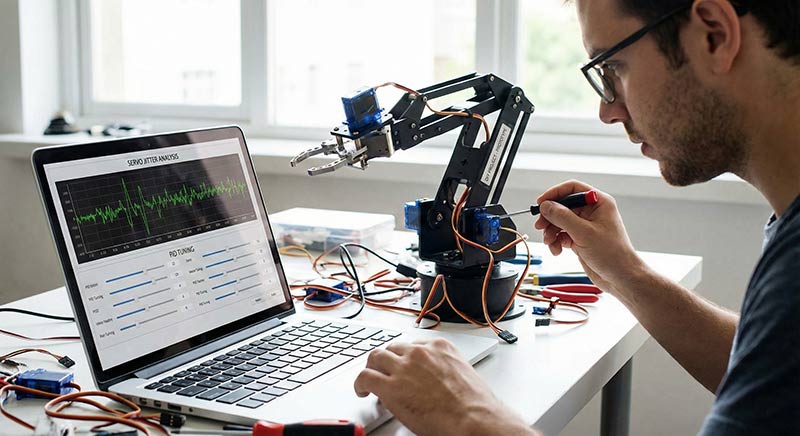
In summary, resolving robot servo motor vibration issues requires both troubleshooting mechanical and power supply problems (“hardware defects”) and optimizing parameters using advanced tuning systems (“software tuning”). Through scientific tuning, your robot will operate more smoothly and intelligently.
Post time: Dec-05-2025